Eight Years of Doing More: How Four Co-Founders Helped Crack Open the Door on Mental Health in Agriculture
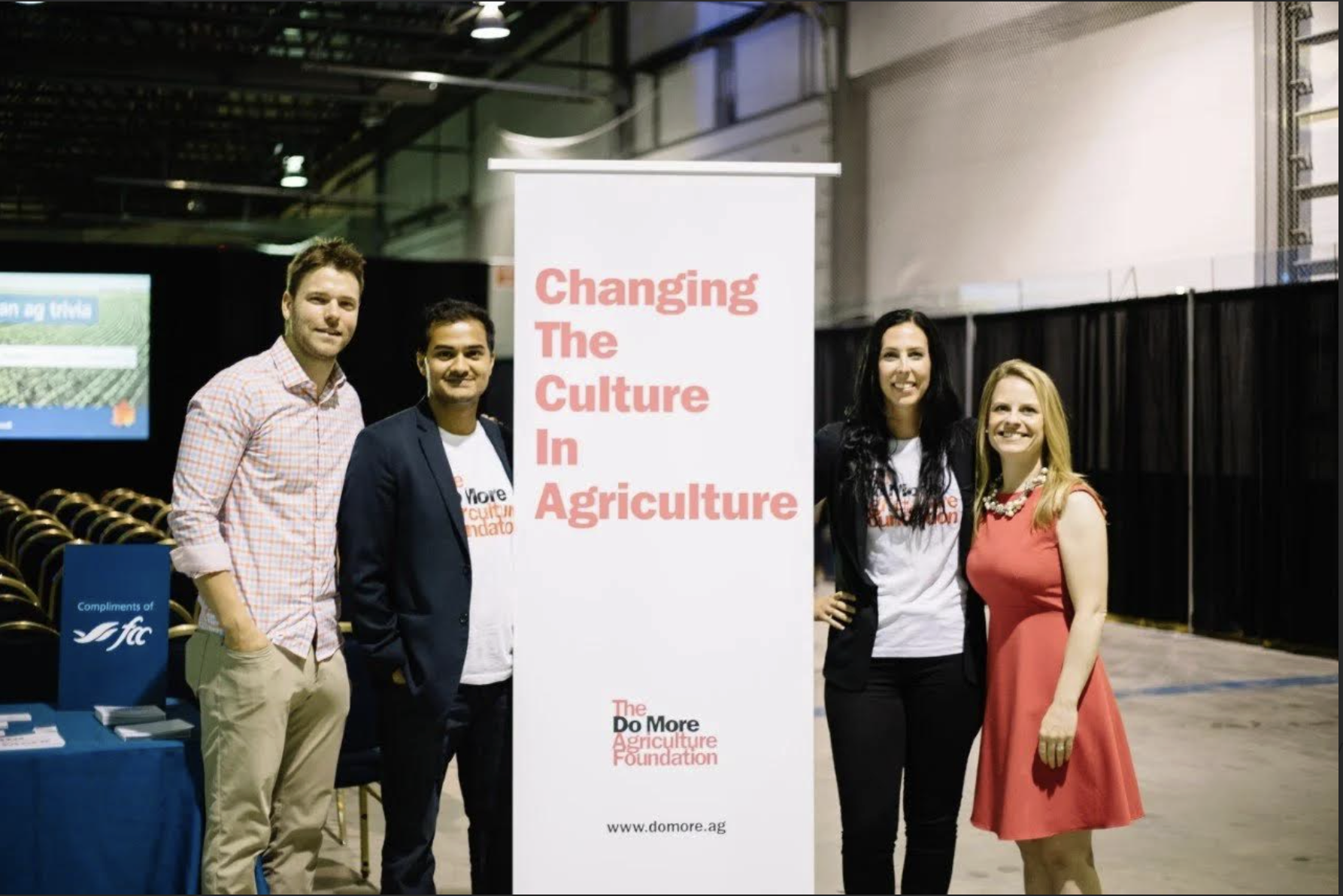
Co-founders of The Do More Agriculture Foundation (from left): Kirk Muyres, Himanshu Singh, Kim Keller and Lesley Kelly
By Lesley Kelly, farmer and co-founder of The Do More Agriculture Foundation
Eight years.
That number can feel impossible to say out loud, because in some ways it still feels like we’re just getting started. And in other ways, it feels like The Do More Agriculture Foundation (often referred to as Do More Ag) has been woven into the fabric of Canadian agriculture far longer than eight years.
When we first started building what would become Do More Ag, it didn’t come from a polished strategy or a perfectly timed plan. It came from a shared feeling that too many people in agriculture were struggling quietly… and too many of us didn’t know what to do about it.
In 2017, four of us started gathering around the same question. Kirk Muyres (a professional curler and farmer), Himanshu Singh (co-founder of Farm At Hand), Kim Keller (co-founder of Farm At Hand and farmer), and I (a farmer and marketer) began meeting, planning, and asking the hard questions: Why are so many farmers suffering in silence? What does the industry need to help farmers with their mental health? We were united by one belief: Mental health belongs in agriculture just as much as markets, weather, and equipment.
How it started: a tweet, a video, and a fundraiser
The part people often don’t know is: We didn’t all start out as best friends or business partners. In fact, Do More Ag began the way most meaningful things do: through small moments, shared values and people paying attention.
At the time, Kim, Himanshu, and I were acquaintances. We knew of each other through agriculture circles, but none of us were sitting around planning to launch a national organization.
Then, in the summer of 2017, Kim sent out a tweet that would become one of the most pivotal “spark moments” in this whole journey.
She had received a message from someone who was looking for mental health support for a farming family and she couldn’t find anything specific to agriculture. No clear resources. No roadmap. No obvious place to direct them.
As Kim put it: “I remember thinking… how can we have so many programs for everything else, but nothing for this?” Her tweet openly talked about mental health, farm stress and suicide and asked the industry to start talking about mental health and it went viral.
Kim inspired Matt, my husband, and I to share a live video about our own mental health and farm stress. We couldn’t find any farmer mental health stories online, and we knew we couldn’t be the only ones feeling this way. We wanted other farmers and farm families to know they weren’t alone. And honestly, if sharing our story helped even one person feel seen or find the courage to reach out, that was the goal.
The response to that video was immediate. We received hundreds of messages from people saying, “Me too,” sharing their own struggles quietly behind the scenes and recognizing they’d never said it out loud before.
And then came Kirk, who had the spark. He saw that video and reached out. Kirk was involved in a curling calendar fundraiser and asked where he could donate his portion of the proceeds to support farmer mental health. He asked one simple question:
“Is there an organization out there I can donate to that supports farmer mental health?”
And the answer was… no.
There wasn’t one.
And I think that’s when the “maybe we can build it” moment landed. As Kirk said early on: “We keep showing up for each other in every other kind of crisis. Why wouldn’t we show up for this one too?”
Four people. Four strengths. One shared purpose
Each co-founder brought something different and I truly believe that’s why this worked.
Himanshu brought business skills and structure. He could see systems, sustainability and the operational backbone required if this was going to last beyond a moment. “If we want to change culture, we can’t build something fragile,” he said. “We have to build something that’s credible, scalable, and here for the long haul.”
Kim brought focus and drive. She was the one who kept the wheels turning and ensured ideas became action. Even before Do More Ag existed, she and Himanshu had already launched a mental health t-shirt campaign to raise funds and awareness at Farm at Hand, which showed both initiative and proof: people cared and were willing to support. “We didn’t want awareness for awareness’ sake,” Kim reminded us. “We wanted farmers to actually have somewhere to go - real tools, real support.”
I brought the storytelling, marketing, and community-building lens: How to talk about hard things and how to build a platform that was grassroots and felt safe, honest, and relatable.
And Kirk brought connections, momentum, and that ability to gather people around an idea quickly. “This isn’t about one organization,” he’d say. “It’s about a movement.”
A movement built by farmers, for farmers.
At that time we didn’t realize how early we were in the national — and global — conversation about farmer mental health. Do More Ag was the first farmer mental health organization in Canada, and the world.
The moment of public launch (and the industry showing up)
In January 2018, we officially launched publicly at FarmTech, thanks to an opportunity to share our vision on the main stage. At the time, FarmTech was one of the biggest Western Canadian agriculture conferences and that launch gave Do More Ag an early momentum that none of us will ever forget.
We also intentionally aligned with Bell Let’s Talk, a national mental health initiative, because if there was ever a moment to say “mental health belongs in agriculture too,” it was then. We were invited to be part of that campaign day, and it helped bring agriculture into a broader national conversation while also making it feel more natural to talk about mental health at the kitchen table, the coffee shop, and the rink.
And here’s the part I’ll never forget: the support was overwhelmingly positive.
The industry showed up. People stepped up. Farmers. Partners. Media. Sponsors. Community leaders. Ag organizations. People didn’t just say “This matters.” They helped build it.
Quietly, steadily, and in a way that still makes me emotional when I think about it.
The work behind the scenes
What many people didn’t see was what it took behind the scenes. The co-founders volunteered hundreds, if not thousands, of hours. We worked late into the night. We built pieces of Do More Ag on plane rides, on car rides, in tractors, between farm jobs and family life, doing whatever needed doing so Do More Ag could root itself into the industry in a real and sustainable way.
We used to say, and still say: Our hope is that one day Do More Ag ceases to exist, not because the need disappears, but because mental health becomes part of everyday life in agriculture. Not a special conversation. Not a crisis-only response. Just part of how we farm, lead, live, and support one another.
Do More Ag was never meant to carry this alone. We were meant to crack open the door, show why it mattered, and create early momentum but culture change takes community.
And today, I’m proud, because the community from coast to coast is showing up.
We’re seeing mental health added to agendas. Speakers brought in. Support networks growing. Organizations leaning in. Rural communities building momentum. More farmers are talking about it around tables and not just behind closed doors.
Agriculture has always been full of the best people. We rally in times of need. We show up with food, with equipment, with help; no questions asked.
Mental health is getting there too. There is still a lot of work ahead but eight years in, one thing is clear:
This industry is capable of change. And together, we are doing more.